

The workplace has entered a new era.
For decades, offices were designed around predictability. Employees worked in assigned desks, teams stayed in fixed locations, and long-term leases reflected stable organizational structures. Success was measured by occupancy, efficiency, and square footage.
Today’s organizations operate very differently.
Teams form and dissolve around projects. Employees collaborate across cities and time zones. Business priorities shift faster than real estate can adapt. The future workplace is now defined by flexibility, purpose, and the ability to evolve alongside the people who use it.
That was one of the strongest themes to emerge from several recent conversations on the Brave Ideas Podcast at GCUC’s 50th conference. Although each guest approached the topic from a different perspective—enterprise workplace strategy, commercial real estate, and flex operations—they all arrived at the same conclusion:
The future workplace isn’t about giving people a place to work. It’s about giving them the right place to do their best work.
Many office buildings were created for a world built around consistency. Modern work is anything but consistent.
Phil Kirschner, workplace strategist and publisher of The Workline newsletter, argues that organizations have become dramatically more dynamic while the physical workplace has remained largely static. Teams increasingly operate with greater autonomy, projects evolve rapidly, and employees need environments that support different types of work.
Instead of viewing the office as a destination, Kirschner encourages organizations to think of it as one component within a broader workplace ecosystem.
He describes a future where employees move seamlessly between headquarters, satellite offices, flex spaces, customer locations, and collaborative environments based on the work they’re doing that day. Rather than redesigning a single office to accommodate every possible task, organizations should create access to a network of purpose-built spaces that better support focus, collaboration, learning, client meetings, and innovation.
This shift requires more than flexible furniture or attractive amenities.
It requires a new philosophy: the workplace should adapt to people, not force people to adapt to the workplace.
Enterprise organizations have already begun changing how they think about real estate.
For years, flexible workspace was often treated as a temporary solution: a place to accommodate overflow staff or short-term growth. Today, it has become an intentional part of long-term workplace strategy.
Commercial real estate advisors Shay Bolton and Kirill Azovtsev explained that enterprise occupiers are now considering flexibility at the beginning of workplace planning rather than at the end. Flexible workspace provides organizations with optionality, allowing them to scale, support distributed teams, host events, and respond more quickly to changing business needs.
But the conversation extends well beyond office space.
Modern occupiers increasingly evaluate hospitality, customer service, wellness amenities, conference facilities, technology, and operational support alongside the physical workplace itself. In many cases, these experiences have become just as valuable as the office footprint.
The future workplace is becoming a service platform rather than simply a collection of desks.
Organizations are investing in environments that help attract talent, improve collaboration, and create better employee experiences.
As workplace expectations evolve, so do relationships across commercial real estate.
Historically, landlords and tenants operated through relatively straightforward lease agreements. Today, those relationships are becoming much more collaborative.
Bolton and Avastov described how many building owners are now working alongside workplace operators to improve hospitality, manage amenities, enhance customer experiences, and even influence building design itself. Rather than functioning as separate businesses occupying the same property, landlords and operators increasingly succeed when they build value together.
That collaboration is changing how buildings compete.
Flexible workspace has evolved from a niche offering into an important amenity that supports tenant retention, accommodates business growth, and creates long-term value throughout an office building. In larger office properties especially, flexible workspace can extend tenant lifecycles by providing expansion space, temporary project space, and meeting facilities without requiring companies to relocate.
The future workplace is changing how buildings themselves are operated.
Choice sits at the center of the future workplace.
Employees increasingly expect the ability to work where they can be most productive, while organizations need better visibility into how those choices impact performance.
Kirschner believes data will play a much larger role in helping organizations understand workplace behavior. Teams that move between spaces, collaborate across different environments, and intentionally choose settings that match their work often demonstrate stronger engagement and better outcomes than those trying to recreate assigned seating in flexible environments.
Artificial intelligence will likely accelerate this evolution.
Rather than forcing employees to decide where to work on their own, future workplace systems may recommend optimal meeting locations, coordinate hybrid schedules, reserve space automatically, and even optimize travel between locations.
The workplace becomes less static and more responsive.
Innovation alone doesn’t build sustainable businesses.
One of the most refreshing perspectives came from Chiko Abengowe, Founder and CEO of Perfect Office Solutions, whose company has continued to grow through disciplined operations. At the same time, much of the industry has chased increasingly complex deal structures.
His philosophy is remarkably simple.
Know your customer.
Understand your economics.
Stay focused on what works.
Abengowe built his business by solving a problem he personally experienced as a first-time entrepreneur: finding professional, affordable office space without unnecessary barriers. That clarity continues to shape every location they open today.
While workplace models will continue evolving, his perspective offers an important reminder.
The future workplace doesn’t eliminate business fundamentals.
Successful operators still need strong unit economics, sustainable growth, thoughtful partnerships, and deep customer understanding. Flexibility without financial discipline results in instability.
As Abengowe noted, the businesses that thrive balance both mission and margin. They care deeply about serving entrepreneurs while maintaining the operational discipline necessary to continue serving them for years to come.
If there was one consistent message across every Brave Ideas conversation, it was this:
The future workplace isn’t defined by a building.
It’s defined by choice.
Choice to work where collaboration happens naturally, to access spaces built for different kinds of work, and choice for organizations to scale without unnecessary constraints.
Choice for landlords and operators to create partnerships that improve the workplace experience rather than simply lease square footage.
And perhaps most importantly, the choice to design workplaces around people instead of expecting people to adapt to workplaces.
The organizations leading this transformation aren’t asking, “How do we get employees back into the office?”
They’re asking a much better question:
“How do we create workplaces people genuinely want to use?”
The answer to that question will define the future workplace for years to come.

As companies demand more flexibility, traditional office real estate must rethink how it operates. Tuomas Sahi, CEO of Antiloop, shares how combining fixed leases with flexible workspace can create value for property owners while better serving the people who use their buildings. Discover why the future of office real estate is about more than owning space. It’s about understanding work.
Read More
Roger Bruce, CEO of Workspace Geek, joins Liz Elam to explore the future of coworking, from AI and actionable data to smarter operations and the continued importance of human connection.
Read More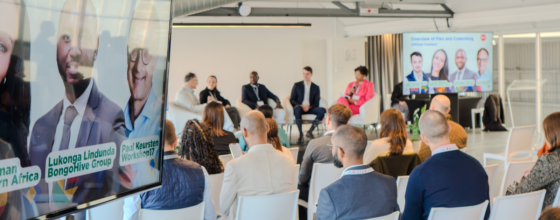
GCUC Africa brought the global coworking community to Cape Town for the first time, connecting operators, sharing ideas, and exploring Africa’s role in the future of work.
Read More
GCUC Access is turning a challenge to the coworking industry into action. Learn how Danielle Casey and 1909 are making mental health support part of founder support.
Read More
What does the future of coworking in Africa look like? Ikigai’s Nyambura Gichohi joins Liz Elam to discuss nature-based wellness, intentional growth, flexible workspace for NGOs, and the opportunities ahead for African coworking operators.
Read More
What happens when you rethink the meeting as an experience? Liz Elam talks with Elliott Sparsis of Together about hospitality, AI, physical connection, and the future of meetings.
Read More
Your coworking technology should make your business easier to run, not create another layer of complexity. Here’s what operators should consider when evaluating their tech stack.
Read More
Workshop17 co-founder Paul Keursten shares how coworking communities in Africa are growing through culture, hospitality, and human connection. Listen to him share what global operators can learn from their journey on the GCUC Podcast.
Read More
Why do coworking members really leave? It’s rarely about price or amenities. Discover how belonging drives coworking member retention and why GCUC’s Summer Series is helping operators build stronger, longer-lasting communities.
Read More
The future of flex offices is no longer defined by leases alone. Leaders across commercial real estate are embracing customer experience, enterprise flexibility, hospitality, and operational excellence to create workplaces that people genuinely want to use.
Read More


